Quick Answer
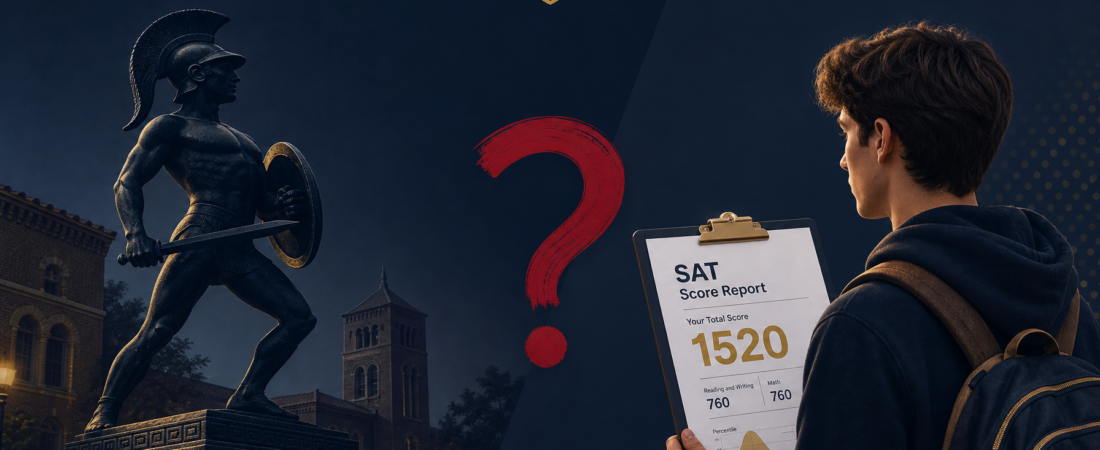
No, USC is not test blind. The University of Southern California is test optional, which is a fundamentally different policy. Test optional means you choose whether to submit SAT or ACT scores — and if you do, USC will consider them. A strong score (1480+) can strengthen your application at a school with a 10% acceptance rate. Students should prepare seriously for the SAT and make a strategic submission decision based on their score. Gangnam Prep has spent 17 years in Diamond Bar, CA helping students achieve a 200+ point SAT score improvement using the Logic-First Framework™ and 3-Round Scan & Strike™ system.
Related Reading
- How to Improve Your SAT Score 200+ Points: The Logic-First F
- ACT vs. SAT for Diamond Bar Students: Which Test Is Right fo
Every year, families in Diamond Bar, Walnut, Brea, and Fullerton ask the same question about one of California’s most coveted universities: Is USC test blind?
It is a reasonable question. The phrase “test blind” has entered the mainstream vocabulary of college admissions, and the distinction between test blind and test optional is genuinely confusing — even for well-informed students and parents. But the confusion carries real strategic consequences. Getting this wrong can lead students to skip SAT preparation for a school where a strong score could have made the difference between an offer and a rejection.
This article answers the question definitively, breaks down what the policy actually means for your application, and explains the specific SAT preparation strategy that puts USC-bound students in the strongest possible position.
Test Blind vs. Test Optional: The Distinction That Changes Everything
These two terms sound similar. They are not.
Test blind means a school will not review your SAT or ACT scores under any circumstances. Submitting them does nothing — the admissions committee will not see them, weight them, or factor them into any part of the decision. A handful of institutions in the United States operate this way, permanently removing standardized tests from the admissions calculation.
Test optional means you decide whether to submit scores. If you submit, the school reviews them. If you choose not to, your application is evaluated without them — but the scores you could have submitted are still relevant to how competitive you are relative to other applicants who did submit strong scores.
USC is firmly in the second category.
According to USC’s official admissions FAQ: “Under this policy, the applicant decides if they would like their SAT or ACT scores to be considered. When students apply to USC, they will be asked to indicate whether they plan to submit scores.”
That is the definition of test optional. It is not test blind. The scores are available to submit, they are reviewed when submitted, and — as the data below shows — the students who are getting in at USC are scoring at very high levels on the SAT.
Why This Confusion Matters for Southern California Students
In the Los Angeles area and throughout the Southern California suburbs, USC occupies a unique place in the college application landscape. It is geographically accessible, academically elite, and culturally significant to students from Diamond Bar, Walnut, and surrounding communities. A large number of Gangnam Prep students have USC on their list — often alongside schools like NYU, Georgetown, Notre Dame, and Emory.
The danger of believing USC is test blind is this: students stop preparing for the SAT. They reason that the test does not matter. They deprioritize it. And then they discover — often too late — that USC’s admitted students who submitted scores are scoring in the 1400s and 1500s, that most of their peer applicants are submitting scores, and that they are competing without one of the few objective data points in the entire application.
The test optional label does not mean the SAT is irrelevant. It means the decision about whether to submit is now yours to make strategically.
USC’s Current Testing Policy in 2026
For the 2025–26 admissions cycle, USC maintains a test optional policy. You are not required to submit SAT or ACT scores to be considered for admission.
However, two critical context points deserve attention:
First, the broader admissions landscape is shifting rapidly. Harvard, Yale, Dartmouth, Brown, MIT, Caltech, Stanford, Cornell, and the University of Pennsylvania have all reinstated mandatory test score requirements for the 2026–27 admissions cycle. Princeton is moving to test required for 2027–28. The test-optional era at the most selective American universities is contracting, not expanding. Whether USC follows this trend is an active question — families applying in future cycles should monitor USC’s admissions announcements closely.
Second, even within the current test optional policy, submitting a strong score is almost always advantageous at USC’s selectivity level. When a school receives over 79,000 applications for roughly 3,700 spots, admissions officers need signals. A score above the class median gives them one.
What the SAT Data Says About USC Admitted Students
Here is the current profile of USC’s admitted class, based on data from the Class of 2029 (the most recently published entering class):
| Metric | Data |
|---|---|
| Total Applications (2025–26) | ~79,290 |
| Admitted Students | ~9,251 |
| Overall Acceptance Rate | ~10.4% |
| New First-Year Students Enrolled | 3,759 |
| SAT Middle 50% Range | 1410 – 1540 |
| ACT Middle 50% Range | 32 – 35 |
| Average GPA (Class of 2030) | 3.92 (all-time record) |
| National Merit Scholars | 122 |
| Testing Policy | Test Optional (NOT test blind) |
The middle 50% SAT range of 1410–1540 tells you several important things. First, the students who submitted scores and were admitted at USC are scoring well above the national average SAT score of approximately 1060. Second, the 25th percentile sits at 1410 — meaning that a quarter of admitted students who submitted scores came in below that, but the majority were well above it. Third, targeting a score of 1480 or higher puts a student in a genuinely competitive range.
These are the students you are competing against.
Should You Submit Your SAT Score to USC?
This is the most important strategic question, and the answer depends on your score relative to USC’s profile.
| Your SAT Score | Recommendation | Reasoning |
|---|---|---|
| 1540+ | Submit — Strong Advantage | Above the 75th percentile. A clear differentiator that signals exceptional academic ability. |
| 1480 – 1539 | Submit — Solidly Competitive | In the upper half of the middle 50%. This score strengthens the application without question. |
| 1410 – 1479 | Submit with Strong Narrative | At the lower end of the competitive range. Submitting can still help if the rest of your application is strong. Consider one more attempt to improve. |
| Below 1410 | Withhold — and Prepare to Retake | Below the 25th percentile of admitted students who submitted scores. Withholding is likely the stronger move, but a significant improvement before the deadline changes this calculus entirely. |
Note: This table reflects data for USC (University of Southern California), a private university. Do not confuse USC with the University of California system, which operates under a permanently test-blind policy.
The Score Submission Myth: “Most Students Don’t Submit”
One of the more persistent misconceptions about test optional schools is the idea that most students in the applicant pool do not submit scores. The data consistently contradicts this at highly selective institutions.
At schools with acceptance rates below 15%, the majority of admitted students who submitted scores land at or above the 75th percentile of the class profile. The students choosing not to submit tend to be those whose scores fall below the institutional range — which means the competition among score-submitters skews even higher than the published middle 50% suggests.
At a school like USC, where the acceptance rate has dropped from 17% in 2015 to approximately 10% today, you are not competing against the average test taker. You are competing against a highly self-selected pool of driven, high-performing applicants — many of whom will submit scores well above 1480.
The test optional label shifts the choice to you. It does not lower the bar.
How to Prepare for the SAT If You Are Targeting USC
Preparing for the SAT with USC as your target school means aiming for the upper half of their admitted class range — ideally 1500 or above. Reaching that range from a starting point of 1200 or 1300 requires understanding how the SAT actually works at a structural level, not just completing practice tests and hoping for the best.
Here is what that preparation actually looks like, based on 17 years of working with Southern California students aiming at top universities.
The SAT Is an Argument Comprehension Test, Not a Reading Test
The single most important reframe for SAT Reading and Writing preparation: the SAT does not measure how much you read or how fast you read. It measures whether you can track an author’s logical position — what they are arguing, how they support it, and what evidence connects to which claim.
Every question in the Reading and Writing module falls into one of several distinct categories: vocabulary in context, big picture and main idea, literal comprehension, function and purpose, text completion, supporting and undermining, graphs and charts, and paired passages. Each category has a specific attack strategy. Students who treat every question the same way — reading the passage, then looking at the choices, then choosing what “sounds right” — are playing a game designed to trap them.
The students scoring 1500+ on the SAT are not faster readers than the students scoring 1300. They are more systematic in how they approach each question type.
The Logic-First Approach: Pre-Empt Before You Look at the Choices
The single highest-leverage technique in SAT Reading preparation is this: form your own answer before reading the answer choices.
SAT wrong answers are crafted to sound reasonable. They often contain real words from the passage, refer to topics discussed in the passage, and feel intuitively plausible. The only reliable way to avoid being misled is to decide what the correct answer should say — in your own words, independent of the four choices — before the choices can influence your thinking.
This is called pre-empting. It sounds simple. It is not easy. Most students skip it because it feels slower, especially under time pressure. But the students who master this technique consistently eliminate the trap answers that cost everyone else 50 to 100 points.
The process for every Reading and Writing question:
- Read the question slowly. Know exactly what is being asked — a main idea question and a function question look similar on the surface but require completely different strategies.
- Return to the passage and locate the relevant section. For function questions, read the sentence before and after the reference. For main idea questions, focus on the first and last sentences of the passage.
- Answer in your own words before looking at the choices. Write a brief note — a few seconds, semi-legible. This is the pre-empt.
- Read all four choices in order. Select the one that matches your independent answer.
The Seven Categories of Wrong Answers
Understanding why a wrong answer is wrong is more valuable than simply knowing a right answer. The SAT uses a consistent set of wrong-answer structures across every question type:
- Off-topic: Discusses something not in the passage
- Too broad: Shifts from specific to general (e.g., “all scientists” when the passage mentions one scientist)
- Too extreme: Uses absolute language — “never,” “always,” “impossible”
- Half-right, half-wrong: Contains correct passage language but draws a false conclusion
- Plausible but unsupported: Could be true, but the passage does not explicitly say it
- Correct for the passage, wrong for the specific lines cited: Uses real information in the wrong context
- Factually true but not stated: True in the real world, but the author never says it
Teaching students to identify which category they fell into — not just that they got it wrong — is the difference between a student who improves 50 points and a student who improves 200+.
Why Vocabulary Questions Are the Most Misunderstood on the Test
Vocabulary-in-context questions are the most common question type on the Digital SAT, and the most commonly misapproached. Students who study vocabulary lists in the traditional sense — memorizing primary definitions — are preparing for the wrong version of this question.
The SAT tests secondary and contextual meanings of ordinary words. Words like “control,” “challenge,” “address,” “advance,” “register,” “bear,” and “yield” are tested not for their most common definitions but for the specific contextual meaning they carry in the passage.
The correct technique is to identify the context clues in the sentence and predict your own word before looking at the choices, selecting the one that preserves the logical meaning of the sentence. This requires understanding the surrounding argument, not just the word in isolation.
Students who approach vocabulary questions by relying on “what sounds right” are relying on instinct over logic — and the SAT is designed to punish exactly that instinct.
The Adaptive Format and the Module 1 Imperative
The Digital SAT is adaptive. Your performance on Module 1 determines which version of Module 2 you receive. Strong Module 1 performance routes you to harder questions in Module 2 — and those harder questions carry the higher score ceiling. A student who makes careless errors in Module 1 gets routed to easier questions, caps their scoring range, and cannot reach 700+ on the Reading and Writing section regardless of how well they perform in Module 2.
This structure makes early-question accuracy disproportionately important. Vocabulary and fill-in-the-blank questions appear first in each module — they are the gateway questions. Students who rush through them to save time for the harder questions at the end are making a strategic error. The correct approach is deliberate, careful execution on every question, from the first vocabulary question to the last paired passage.
The 3-Round Scan & Strike: A Time-Boxed Pacing Strategy
Time management on the SAT Reading and Writing module is one of the most common failure points for students targeting the 1500 range. The 32-minute module rewards students who can allocate their time deliberately across three rounds of engagement:
Round 1 (approximately 14 minutes): Move through all questions, but answer only the ones you are fully certain about. Skip anything that requires extended deliberation. The goal here is to lock in your easy and medium points without wasting time on hard questions that may resolve with a second pass.
Round 2 (approximately 10 minutes): Return to skipped questions. Your eyes are now fresh, and exposure to the question a second time activates pattern recognition that was not available on the first pass. Cherry-pick key information from the passage rather than rereading from scratch.
Round 3 (approximately 8 minutes): Final pass. This is a pattern recognition and elimination round. With full awareness of your remaining time, apply the elimination framework to resolve outstanding questions. Never leave a blank — there is no penalty for a wrong answer.
The key insight behind this strategy is that repeated exposure to difficult questions forces students to notice what they missed the first time. Students who stare at a hard question until they “feel” they understand it are spending time that could resolve easier questions and come back with sharper eyes later.
The USC Advantage for Southern California Students
For students in Diamond Bar, Walnut, Brea, Fullerton, and surrounding communities, USC holds a particular appeal that goes beyond rankings. It is a research university with the resources of a large institution and the cultural identity of a tight community. Programs like the USC Marshall School of Business, the Viterbi School of Engineering, and the School of Cinematic Arts are among the most respected in their respective fields nationally.
But USC’s acceptance rate tells the full story: roughly 1 in 10 applicants is admitted. In that context, a SAT score in the top quartile of the admitted class is not a luxury — it is a strategic asset. It is one of the few quantitative signals that cuts through the holistic review process and communicates, objectively, that a student can handle the academic demands of a highly selective research university.
The students who arrive at Gangnam Prep with a 1300 and a USC application in mind are not hopeless. They are 12 to 16 weeks away from a score that changes the conversation.
Targeting USC? Let’s Build the Score That Gets You There.
Gangnam Prep students gain an average of 200+ points using our proprietary Logic-First methodology. With USC’s acceptance rate at 10%, a SAT score above 1500 is not optional — it is your advantage. Book a free consultation to find out exactly where you stand and what it takes to get there.
Daily SAT strategy on Instagram: @gangnamprep
Frequently Asked Questions
Is USC test blind?
No. USC (University of Southern California) is test optional. A test blind school will not review your SAT or ACT score under any circumstances. USC is not test blind — if you submit a score, USC will review and consider it as part of your holistic application.
Is USC test optional in 2026?
Yes. For the 2025–26 admissions cycle, USC maintains a test optional policy. You are not required to submit SAT or ACT scores. However, given that USC’s acceptance rate is approximately 10%, applicants with scores at or above the class mid-50% range (1410–1540) are strongly advised to submit them.
What SAT score do I need for USC?
The middle 50% SAT range for admitted USC students is 1410–1540. A score of 1480 or above puts you in the competitive zone. For the most selective USC programs — Marshall Business, Viterbi Engineering, Cinematic Arts — targeting 1520 or above is advisable.
Should I still prep for the SAT if I am applying to USC?
Yes. Even at a test optional school, a score in the upper tier of the admitted class profile strengthens your application materially. USC receives over 79,000 applications per year and admits roughly 10%. Every objective signal of academic ability helps. Students who reach 1480+ through deliberate SAT preparation give themselves a meaningful advantage in a highly competitive process.
When is USC becoming test required?
As of 2026, USC has not announced a return to mandatory testing. However, the trend among highly selective universities is moving in that direction. Harvard, Yale, Dartmouth, MIT, Stanford, and others have already reinstated test requirements. Students planning to apply to USC in 2027 or beyond should monitor USC’s official admissions announcements and prepare a strong SAT score regardless of the prevailing policy.
Disclaimer: College admissions policies change. The information in this article reflects USC’s official admissions policy and class profile data as of June 2026. Students should always verify current policy directly with USC’s Office of Admission at admission.usc.edu. Gangnam Prep is an independent SAT tutoring service and has no affiliation with the University of Southern California.