Quick Answer
To score 700+ on Digital SAT Reading and Writing, treat it as an argument comprehension test, not a reading fluency test. Use a four-step logic process for every question, learn to identify the seven categories of wrong answers, and apply the 3-Round Scan & Strike method to manage the 32-minute module without stalling on hard questions. Students who master this approach at Gangnam Prep average 200+ points of improvement. Gangnam Prep has spent 17 years in Diamond Bar, CA helping students achieve a 200+ point SAT score improvement using the Logic-First Framework™ and 3-Round Scan & Strike™ system.
Most students who walk into SAT prep frustrated with their Reading score share one assumption: they need to read faster, or read more, or simply understand the passages better.
That assumption is wrong — and it is costing them points every single test.
The Digital SAT Reading and Writing section is not a reading fluency exam. It is an argument comprehension test. It measures whether you understand not just what a text says, but how and why the author says it — and whether you can evaluate the logical relationship between a question, a passage, and four carefully engineered answer choices.
Students who approach it as a reading test plateau in the 580–640 range. Students who approach it as a logic test score in the 700s.
At Gangnam Prep, we have spent 17 years refining a system that turns the second group into the first. This guide explains exactly how.
How the Digital SAT Reading and Writing Module Works
| Feature | Details |
|---|---|
| Modules | Two 32-minute modules (64 min total) |
| Questions per module | 27 (54 total) |
| Passage length | 50–150 words per passage, one question each |
| Adaptive structure | Module 1 difficulty determines Module 2 difficulty |
| Content domains | Fiction, Humanities, Social Science, Natural Science |
| Question order | Vocabulary and fill-in-blank questions appear first; harder reasoning questions come last |
The 8 Question Types on Digital SAT Reading and Writing
| # | Question Type | What It Asks |
|---|---|---|
| 1 | Vocabulary in Context | “Which choice completes the text with the most logical and precise word or phrase?” — tests secondary meanings, not dictionary definitions |
| 2 | Big Picture / Main Idea | “Which choice best states the main idea?” — almost always answered by the first or last sentence of the passage |
| 3 | Literal Comprehension | “According to the text…” — the correct answer rephrases the passage with synonyms, never word-for-word |
| 4 | Function / Purpose | “Which choice best states the function of the underlined sentence?” — asks about the logical role of a sentence within the argument |
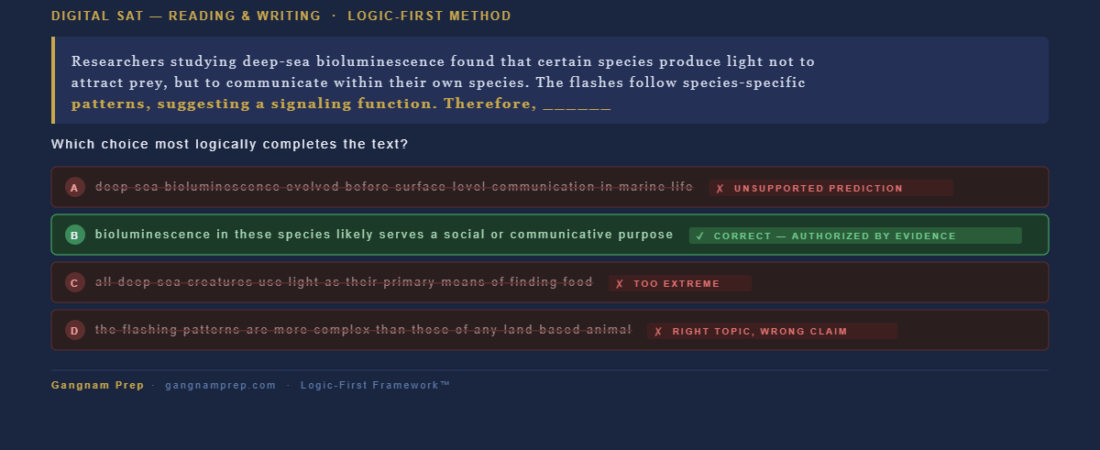
| 5 | Text Completion | “Which choice most logically completes the text?” — a logic question determined by the argument’s structure |
| 6 | Supporting & Undermining | “Which quotation most effectively illustrates the claim?” — requires identifying the exact claim before selecting evidence |
| 7 | Graphs & Charts | Data interpretation alongside the passage — the anchor is always the specific claim in the question stem |
| 8 | Paired Passages | Two short texts with related or conflicting perspectives — tests whether you can precisely identify each author’s position |
Why Strong Students Still Score Below 650
- Picking answers that “sound right” instead of answers the passage explicitly supports
- Confusing what the author discusses with what the author argues
- Word-for-word matching — choosing answers that contain exact phrasing from the passage
- Scope errors — not catching when an answer shifts from a specific claim to a general one
- Skipping pre-emption — looking at the four choices before forming an independent answer
- Ignoring transition words — skipping “however,” “therefore,” “despite”
- Vocabulary overconfidence — knowing a word’s primary meaning but missing its secondary meaning
- Not isolating the exact claim on Supporting & Undermining questions
- Screen-reading habits — skimming passively
- Stalling on hard questions — spending 3–4 minutes on a single passage
The Logic-First Framework: 4 Steps for Every Question
Step 1: Read the question stem first
Before touching the passage, read the question stem slowly and identify exactly what is being asked.
Step 2: Return to the passage and find the relevant section
Locate the lines or sentences the question references. Use structural signals as your roadmap: transition words (however, therefore, despite), colons and dashes, and strong language (only, never, important, crucial). The answer lives near these signals — this is called the Proximity Rule.
Step 3: Form your own answer before looking at the choices
This is the most important step — and the one most students skip. Write a brief note that captures what the correct answer should say. When you form an independent answer first, you break the psychological grip of the wrong answer choices, which are specifically engineered to sound plausible.
Step 4: Read all four choices in order and match
Read A through D in order and select the choice that matches the answer you formed in Step 3. If a choice matches, select it immediately and move on.
The 3-Round Scan & Strike Method
| Round | Time Allocation | What You Do |
|---|---|---|
| Round 1 | 14 minutes | Attempt all 27 questions. Answer only those you are 100% certain about. Flag and skip anything uncertain — do not stall. |
| Round 2 | 10 minutes | Return to flagged questions. Cherry-pick key information from the passage — your second exposure produces sharper pattern recognition. |
| Round 3 | 8 minutes | Final pass. Use time awareness and pattern recognition built over Rounds 1 and 2. Resolve all remaining questions — never leave a blank. |
Students at Gangnam Prep are not allowed to stall. The moment a question triggers uncertainty, it gets flagged and skipped. Round 1 momentum is non-negotiable.
Wrong Answers Are Not Random: The 7 Categories
- Off-topic — The answer discusses something the passage never mentions
- Too broad — The answer shifts from a specific claim to a general one — the scope trap
- Too extreme — Uses absolute language: never, always, completely, impossible
- Half-right, half-wrong — Contains accurate words from the passage but makes a false overall statement
- Plausible but unsupported — Could be true, but the passage never actually says it
- Correct for the passage but wrong for the specific lines — Uses real passage information in the wrong context
- Factually true but not stated in the passage — True in the real world, but the author never says it
Why Module 1 Is Where the Test Is Really Won
Module 1 determines which version of Module 2 you receive. Strong performance in Module 1 routes you to the harder Module 2, which has a higher scoring ceiling. That harder Module 2 is the only path to 700+. Students who make careless errors in Module 1 get routed to easier questions in Module 2 — questions that cap their total score regardless of how well they perform.
How Gangnam Prep Students Improve 200+ Points
| Phase | Focus | Typical Score Gain |
|---|---|---|
| Phase 1 | Diagnostic, question-type identification, Logic-First framework drills | +40–60 pts |
| Phase 2 | Wrong-answer taxonomy, pre-emption drills, structural signal navigation | +60–80 pts |
| Phase 3 | Full-length adaptive practice, 3-Round Scan & Strike pacing, Module 1 precision | +50–80 pts |
These gains apply across all students — from freshmen starting at 450 to juniors targeting 1500 who need to close a 50-point gap.
Average score improvement figures are based on Gangnam Prep students who complete a full program of instruction. Individual results vary based on starting score, frequency of sessions, and student practice consistency.
Frequently Asked Questions
What is on the Digital SAT Reading and Writing section?
The Digital SAT Reading and Writing section consists of two 32-minute adaptive modules, each with 27 questions (54 total). Each passage is 50–150 words paired with exactly one question. The eight question types are: Vocabulary in Context, Big Picture/Main Idea, Literal Comprehension, Function/Purpose, Text Completion, Supporting and Undermining, Graphs and Charts, and Paired Passages.
Why do strong readers still score below 650?
Because the Digital SAT tests argument comprehension and rhetorical skill, not reading fluency. Strong readers often pick answers that sound right rather than answers the passage explicitly supports. Without a systematic method for identifying wrong-answer categories and pre-empting the correct answer, even advanced readers plateau in the 580–650 range.
What is the most important single habit for SAT Reading improvement?
Forming an independent answer before looking at the four choices. This prevents the wrong-answer options from hijacking your reasoning. Students who master this habit typically improve 30–50 points on Reading alone within a few weeks of consistent practice.
How important is Module 1 on the Digital SAT?
Disproportionately important. Strong performance in Module 1 routes you to the harder Module 2, which is the only path to 700+. A student who makes careless errors in Module 1 is capped below 700 regardless of Module 2 performance.
How long does it take to improve significantly on SAT Reading?
Most students see measurable improvement within 4–6 weeks of targeted instruction focused on method, not content memorization. Reaching the 700+ range from a starting score of 500–550 typically requires a 3–4 month structured program.
Ready to break 700 on Digital SAT Reading?
Find out exactly what is holding your score back. Gangnam Prep offers a free consultation where we diagnose your specific error patterns and outline a precision plan to your target score.
Daily SAT strategy on Instagram: @gangnamprep
Free · No obligation · Available in-person (Diamond Bar) and online nationwide