Quick Answer
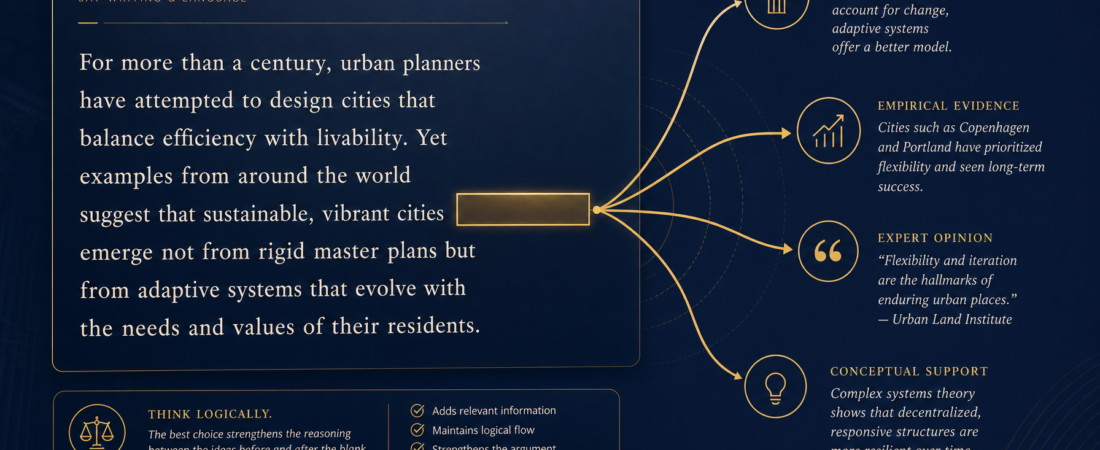
Text completion questions — “Which choice most logically completes the text?” — are logic questions, not vocabulary questions. The correct answer follows inevitably from the argument established in the passage. The method: find the conclusion signal, describe the answer in your own words before looking at the choices, then select the option that fits. Students who look at the choices first lose these questions to answers designed to sound plausible rather than be logically correct. Gangnam Prep has spent 17 years in Diamond Bar, CA helping students achieve a 200+ point SAT score improvement using the Logic-First Framework™ and 3-Round Scan & Strike™ system.
What Text Completion Questions Actually Test
The question stem reads: “Which choice most logically completes the text?”
Every word in that stem matters. “Most logically” tells you the correct answer follows from logic — not from vocabulary, not from what sounds stylistically smooth, not from what seems generally true about the topic. The answer is determined by the structure of the argument the passage has already built.
This is where most students go wrong. They read the blank, look at the choices, and ask: “Which of these words fits here?” That is the wrong question. The right question is: “What idea does the logic of this passage require here?” The distinction determines whether a student gets these questions right consistently or keeps missing them.
Text completion questions are not vocabulary questions. The Digital SAT has a separate question type for contextual vocabulary (“Which choice completes the text with the most logical and precise word or phrase?”). Text completion questions test something different: whether a student can follow an argument to its necessary conclusion.
The Two Text Completion Stem Variants
The Digital SAT uses two related stems for this question category. Both require the same logical approach, but students should recognize the distinction:
| Question Stem | What It Tests | Where the Blank Typically Sits |
|---|---|---|
| “Which choice most logically completes the text?” | The logical conclusion of the passage’s argument | End of the passage — the final idea the argument builds toward |
| “Which choice completes the text with the most logical and precise word or phrase?” | Contextual precision of a single word within a sentence | Mid-sentence — a word whose meaning is determined by surrounding context |
This article addresses the first stem: “Which choice most logically completes the text?” The vocabulary/precision stem is a separate question type that requires a different approach.
The our Logic-First methodology for Text Completion Questions
Every text completion question at Gangnam Prep is processed through the same four-step sequence. The sequence does not change based on topic, difficulty, or which module the question appears in.
Step 1: Find the Conclusion Signal
Before doing anything else, scan the passage for a conclusion signal — a word or phrase that indicates the blank contains the logical result of what came before. These signals are not hidden. They are explicit directional markers:
- Primary conclusion signals: therefore, thus, so, consequently, as a result, it follows that
- Inference signals: this suggests, this indicates, this means, this shows, this demonstrates, which demonstrates
- Restatement signals: in other words, that is, in short, in summary
- Extension signals (no explicit signal word): the blank continues or extends the final point of the passage — no transition word is present, but the logic still requires a specific kind of continuation
When a conclusion signal is present, the blank contains the logical output of the passage’s argument. The passage essentially contains all the information needed to derive the answer — the student’s job is to trace that logic, not to import their own knowledge.
Step 2: Identify the Direction of the Answer
Before reading the choices, determine two properties of the correct answer:
Directionality: Is the passage building toward something positive, negative, or neutral? A passage that describes a scientist who observed unexpected results and then ran additional experiments points toward a conclusion about those experiments — not toward general commentary on scientific rigor.
Scope: Is the passage specific or general? If the passage discusses one species, one researcher, one event — the correct answer must maintain that specificity. An answer that generalizes to a broader population (all species, scientists in general, historical events) is a scope error and is wrong.
Write a two- to three-word characterization of the answer before reading the choices. This does not need to be a complete sentence or a polished phrase — “something about negative outcomes,” “specific claim about the study’s limitation,” or “a contrast to the first point” is enough. The characterization protects you from the wrong-answer choices.
Step 3: Read All Four Choices — Then Select
Read the choices in order (A through D). Select the first choice that matches your pre-formed characterization. Do not second-guess a match once you find it. If two choices appear to match, one of them contains a subtle scope error, an extreme qualifier, or an unsupported claim — re-read both against the passage to identify which one is more precisely supported.
Step 4: Verify with the Passage (Hard Questions Only)
On the hardest text completion questions, the correct answer requires integrating information from two or more sentences rather than extracting it from a single conclusion signal. For these, verify that the selected answer is fully supported by what the passage has explicitly established — not what it implies, not what is plausible, not what is generally true about the topic.
The single most protective habit is this: the correct answer must be 100% supported by the passage text. “It could be true” is not enough. “It sounds reasonable” is not enough. If the passage does not directly establish the premise, the answer is wrong regardless of how plausible it appears.
The Four Wrong-Answer Traps on Text Completion Questions
The Digital SAT uses a consistent set of wrong-answer patterns on text completion questions. Recognizing the category of wrong answer is more powerful than simply knowing the answer is wrong.
| Trap Type | How It Appears | How to Catch It |
|---|---|---|
| Directionally correct, wrong scope | Points the right direction but overgeneralizes or shifts from the passage’s specific subject | Check: does the passage say this specifically, or only something narrower? |
| Too extreme | Uses absolute language (always, never, entirely, completely) that the passage’s evidence doesn’t justify | The passage’s evidence typically supports a conditional claim, not an absolute one |
| Plausible but unsupported | The idea is reasonable given the topic, but the passage never establishes the premise that would make it the logical conclusion | Ask: where in the passage does it establish this? If you can’t point to it, it’s wrong |
| Reversal trap | The opposite of the correct conclusion — designed to catch students who misread the direction of the argument | Re-read the conclusion signal and the sentence immediately before it |
Why This Question Type Rewards the Logic-First Student
Text completion questions are one of the most learnable question types on the Digital SAT. Once a student internalizes the four-step process — find the signal, characterize the direction, predict before reading, verify against text — these questions resolve quickly and cleanly. They do not require broad knowledge, prior familiarity with the topic, or reading speed. They require only the ability to follow an argument.
Students who rely on intuition are at maximum risk on this question type precisely because the wrong answers are designed to feel right. The “plausible but unsupported” trap is particularly effective against strong readers, who often supply their own background knowledge to fill the blank rather than deriving the answer from the passage’s actual logic.
This is the core diagnostic at Gangnam Prep: when a student misses a text completion question, we trace exactly which step they skipped. Almost every missed text completion falls into one of three categories — they looked at the choices before forming a prediction, they allowed a plausible-sounding wrong answer to override their pre-formed answer, or they applied outside knowledge the passage didn’t establish. Each of these is a correctable process error, not a content gap.
How Text Completions Fit in the Module Structure
Understanding where text completion questions appear in the module is itself a pacing advantage. The Digital SAT’s Reading & Writing module is sequenced deliberately: vocabulary questions and basic fill-in-blank items appear early; harder reasoning questions — text completion, supporting/undermining, function/purpose — cluster in the second half of each module (roughly questions 16–27).
For students using the 3-Round Scan & Strike method, text completion questions encountered in the second half of a module are natural Round 2 candidates: skip them cleanly on the Round 1 pass, return with a fresh read and a pre-formed prediction in Round 2, and resolve with pattern recognition in Round 3 if needed. The repeated exposure that makes hard passages more tractable applies equally to this question type.
What is the most common mistake on SAT text completion questions?
Reading the answer choices before forming an independent prediction. The wrong-answer choices are specifically designed to sound plausible. A student who reads the choices first gets anchored to options that feel right rather than options the passage’s logic actually supports. Pre-empting the answer before looking at the choices is the single most protective habit.
What are the conclusion signals to look for?
Primary signals: therefore, thus, so, consequently, as a result, it follows that. Inference signals: this suggests, this indicates, this means, this shows, this demonstrates. Restatement signals: in other words, that is, in short. When any of these appear before the blank, the answer is the logical output of everything established before it in the passage.
How many text completion questions appear on the Digital SAT?
Typically 2–4 per module, concentrated in the second half of each module (questions 16–27). Students routed to the harder Module 2 will encounter more of these questions at their highest difficulty level, making mastery of this question type especially important for students targeting 700+.
Are SAT text completion questions the same as vocabulary questions?
No. Vocabulary questions (“Which choice completes the text with the most logical and precise word or phrase?”) test contextual word meaning. Text completion questions (“Which choice most logically completes the text?”) test logical reasoning about an argument. The approaches are related but distinct — vocabulary questions are answered by substituting options and testing semantic fit; text completion questions are answered by tracing the argument’s logic to its required conclusion.
For students targeting a 1500+ score, the methodology described here is the most direct path.
Stop Losing Points You Should Be Winning
Text completion questions are among the most teachable on the Digital SAT. A free consultation with Gangnam Prep will identify exactly which question types are costing your student points — and give you a concrete plan to fix them.
Daily SAT strategy on Instagram: @gangnamprep