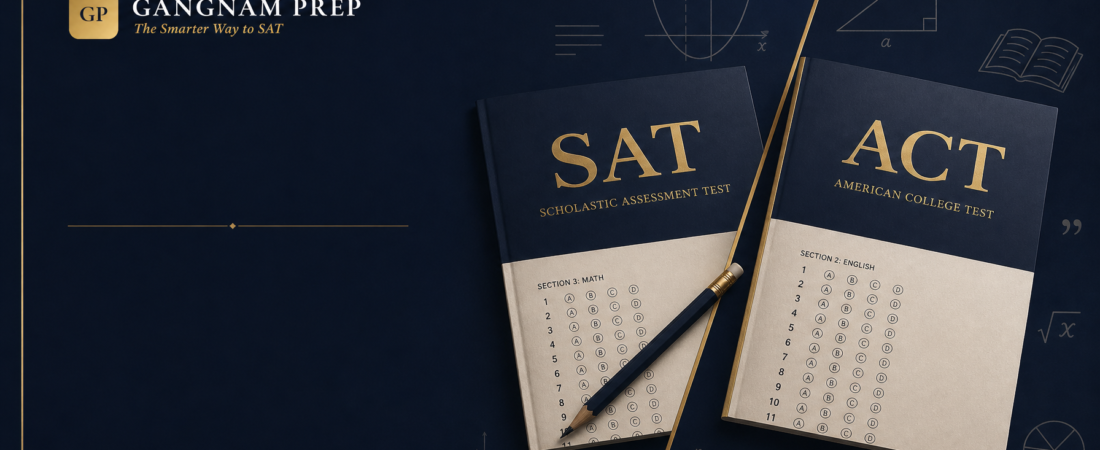
The SAT and ACT are equally accepted by every US college — but they test different strengths. The Digital SAT (2 hrs 14 min, adaptive) rewards logical, precise reasoning on short passages. The ACT (2 hrs 55 min) rewards fast reading and science fluency. Take a diagnostic of each and compare results. If the SAT is your test, the single most important shift you can make is treating it as an argument comprehension test — not a reading fluency test. Gangnam Prep’s Logic-First Framework and 3-Round Scan & Strike method have produced an average 200+ point improvement over 17 years of specialist SAT instruction. Gangnam Prep is based in Diamond Bar, CA with 17 years of experience helping students improve by 200+ using the Logic-First Framework™ and 3-Round Scan & Strike™ method.
Related Reading
- How to Improve Your SAT Score 200+ Points: The Logic-First F
- ACT vs. SAT for Diamond Bar Students: Which Test Is Right fo
Every year, families in Diamond Bar, CA and across Southern California — and increasingly, students nationwide working online — face the same question: SAT or ACT? And once they choose, the second question is almost always: what actually works?
Generic answers fill the internet. This guide does not offer generic answers. What follows is a comprehensive, methodology-driven breakdown of both tests — how they differ, how to choose between them, and exactly how to prepare for the Digital SAT using the specific reasoning frameworks that move students from page 2 scores to 1500+.
SAT vs. ACT at a Glance: 2026 Comparison
Before diving into preparation strategy, understand what you are actually preparing for. The two tests are structurally different in ways that matter significantly for score outcomes.
| Feature | Digital SAT (2026) | ACT (2026) |
|---|---|---|
| Total Time | 2 hrs 14 min | 2 hrs 55 min (no essay) |
| Total Questions | 98 | 215 |
| Sections | Reading & Writing; Math | English; Math; Reading; Science |
| Format | Fully digital, adaptive (Bluebook app) | Paper or digital (student’s choice) |
| Passage Length | Short: 50–150 words, 1 question each | Long: 700–900 words, multiple questions |
| Adaptive? | Yes — Module 2 difficulty based on Module 1 | No |
| Science Section | No (some data interpretation in Math) | Yes — 40 questions, 35 min |
| Scoring Scale | 400–1600 | 1–36 composite |
| Wrong Answer Penalty | None | None |
| Calculator Policy | Allowed entire math section (Desmos built-in) | Allowed on Math Part 2 only |
How to Choose: SAT or ACT?
The single most reliable method for choosing between the two tests is a side-by-side diagnostic: take one full official SAT practice test and one full official ACT practice test, then convert both scores to a percentile. Where your percentile is higher is almost always your better test.
Beyond the diagnostic, certain profiles map more naturally to each test:
| Student Profile | Better Fit | Why |
|---|---|---|
| Strong logical reasoner, slower reader | SAT | Short passages require precision, not speed |
| Fast reader, strong science background | ACT | Speed and science section reward these traits |
| Strong math, comfortable with calculator | SAT | Desmos calculator is available for entire math section |
| English native speaker, high reading volume | ACT | Long passages reward fluent, natural readers |
| English language learner, strong logic | SAT | Short, self-contained passages reduce fluency demands |
| Anxiety-prone, prefers fewer questions | SAT | 98 questions vs 215 reduces cognitive overload |
The Digital SAT Reading & Writing Module: What It Actually Tests
This is where most students have the wrong mental model — and it costs them points they do not need to lose.
The Digital SAT Reading & Writing module is not a reading comprehension test. It is an argument comprehension test. The passages are short (50–150 words), but each one encodes a specific logical structure: a claim, a counterargument, evidence, a concession, a conclusion. Students who approach these passages as narrative reading exercises — absorbing the content and hoping to answer questions from memory — consistently underperform their intellectual ability.
Students who score 750+ on Reading & Writing treat each passage as a logical puzzle. They identify the author’s position, locate the structural signals (transitions, colons, emphasis language), and use those signals to predict the answer before reading the choices.
The Digital SAT Reading & Writing module runs 64 minutes across two 32-minute modules. Each module has 27 questions. Question difficulty increases within each module — vocabulary and fill-in-blank questions appear first, harder reasoning questions appear at the end.
The Adaptive Module Structure
Because the Digital SAT is adaptive, your Module 1 performance gates your score ceiling. A student who performs well on Module 1 is routed to the harder Module 2 — and those harder questions are the only path to a Reading & Writing score above 650. A student who makes careless errors in Module 1, even on questions they “know,” gets routed to easier Module 2 questions and caps out. This makes Module 1 discipline disproportionately important — more important than any single question.
The Logic-First Framework: Gangnam Prep’s Core Methodology for Digital SAT Reading
After 17 years of specialist SAT instruction, one insight recurs across every student profile: students who look at answer choices before forming their own answer get manipulated by wrong answers designed to sound correct. The Logic-First Framework solves this problem at the process level.
Every question — regardless of type — follows the same four steps:
Step 1: Read the question slowly. Know exactly what is being asked before reading a single word of the passage. Function questions and literal comprehension questions look similar but require different strategies. Misidentifying the question type is the first place students lose points.
Step 2: Return to the passage and locate the relevant section. Use structural signals — transition words (however, therefore, despite, consequently), colons, dashes, italics, and emphasis language — as your roadmap. The answer is almost always located physically close to one of these signals.
Step 3: Answer in your own words before reading the choices. This is the single most important step — and the one most students skip. Forming an independent answer, even a rough one, prevents the four choices from hijacking your reasoning. If you cannot form any answer after a few seconds, move directly to Step 4 rather than staring at the passage.
Step 4: Read all four choices in order and select the one that matches your pre-formed answer. Do not change your answer simply because a different choice sounds compelling. Plausibility is not correctness — only textual support determines the right answer.
The 8 Question Types on the Digital SAT Reading Module
Every Digital SAT Reading & Writing question falls into one of exactly eight categories. Students who identify the question type before reading the passage know what to look for — and where to look. Students who read blindly hope the answer reveals itself.
1. Vocabulary in Context
Stem: “Which choice completes the text with the most logical and precise word or phrase?” or “As used in the text, what does the word X most nearly mean?”
The SAT does not test dictionary definitions. It tests whether students understand how a word’s function shifts based on context. The correct answer is rarely the word’s most common meaning — it is almost always a secondary, more formal meaning. Cherry-picking the context clues and predicting your own word works here: check it against the answer choices and identify which one preserves the logical meaning of the surrounding sentence without distortion.
Common traps: The answer that uses the word’s most familiar meaning. The answer that uses a synonym of the target word rather than a contextually precise replacement.
2. Big Picture / Main Idea
Stem: “Which choice best states the main idea of the text?” or “Which choice best describes the overall structure of the text?”
The main idea of a Digital SAT passage lives in the first or last sentence — rarely in the middle. Force yourself to state the author’s claim in one tight sentence before looking at answer choices. If you cannot do it, you have not identified the author’s actual argument. For structure questions, identify the logical progression: claim → evidence? Problem → solution? Observation → analysis? Argument → counterargument → rebuttal?
Key distinction: What an author discusses is not the same as what an author argues. Authors frequently spend most of a passage presenting a view they ultimately challenge. Mistaking a view the author opposes for the author’s own position is one of the most common 700-level errors.
3. Literal Comprehension
Stem: “According to the text, what is true about…?” or “Based on the text, why does X occur?”
The answer is in the passage — but it is almost never stated word for word. The correct answer restates the passage using synonyms: same idea, different words. If an answer choice uses exact phrasing from the passage, treat it with suspicion. It is often a trap. An answer is only correct if the passage explicitly supports it — “plausible” and “factually true in the real world” are not standards for correctness here.
4. Function / Purpose
Stem: “Which choice best states the function of the underlined sentence?” or “Which choice best states the primary purpose of the passage?”
Function questions never ask what a sentence says — they ask what it does. The answer is about the relationship of that sentence to the surrounding text. Read the sentence before it (sets context) and the sentence after it (shows reaction or continuation). Ask: Is this sentence supporting a claim? Providing evidence? Introducing a counterargument? Conceding a point? Defining a term? Establishing contrast?
5. Text Completion
Stem: “Which choice most logically completes the text?”
These are logic questions, not vocabulary questions. The correct answer is determined by the logical structure of the argument. Find the conclusion signal — therefore, thus, so, consequently, this suggests, in other words. The blank usually contains the logical conclusion of the passage’s argument. Predict what kind of idea belongs before reading the choices: is the blank positive or negative? General or specific? Causal or contrasting?
6. Supporting & Undermining
Stem: “Which finding, if true, would most directly support the researchers’ conclusion?” or “Which quotation most effectively illustrates the claim?”
This question type requires a two-step process. Step 1: identify the exact claim being supported or undermined — not the general topic, but the specific conclusion. Step 2: select evidence that most directly connects to that specific claim. The most common error: choosing evidence that is related to the general topic but does not address the specific claim. The correct answer must make the specific claim more or less likely to be true.
7. Graphs & Charts
Stem: “Which choice best describes data from the graph that supports the researchers’ claim?”
Read the graph title and axis labels before reading the passage or question. The claim in the question stem is the anchor — find the data point that specifically supports that claim. Numbers must be checked precisely against the graph. Students who select visually obvious data points without verifying they address the specific claim consistently miss these questions.
8. Paired Passages
Stem: “Based on both texts, how would the author of Text 1 most likely respond to Text 2?”
Two short passages, typically with related but conflicting or complementary perspectives. Read Text 1, answer its questions. Then read Text 2, answer its questions. Then tackle the relationship questions. The key skill: accurately identifying the position of each author — not just what they discuss, but what they argue. The common trap is choosing an answer that describes what one author says about the topic without accurately representing the other author’s actual stance.
The 3-Round Scan & Strike Method: Time Management for the 32-Minute Module
Most time management advice for the SAT is generic: “Don’t spend too long on any one question.” That advice tells students nothing actionable. The 3-Round Scan & Strike method gives students a precise, repeatable structure for exactly how to allocate the 32 minutes of each Reading & Writing module.
| Round | Time Allocation | Objective | Rule |
|---|---|---|---|
| Round 1 | 14 minutes | Attempt all 27 questions | Answer ONLY questions you are 100% certain about. Skip anything that requires hesitation — flag and move on. |
| Round 2 | 10 minutes | Return to flagged questions | Cherry-pick key information from the passage. Attempt with sharper focus — a second exposure reveals details missed the first time. |
| Round 3 | 8 minutes | Final pass | Pattern recognition, time awareness, resolve remaining unanswered questions. Never leave a blank — there is no wrong-answer penalty. |
The core insight behind this method: repeated exposure to hard questions forces the brain to notice things it missed in earlier passes. Students are not allowed to stare at a passage until they “feel” they understand it. The method enforces movement, and movement creates new angles of entry into difficult questions.
The Seven Categories of Wrong Answers
Teaching students why a wrong answer is wrong is more powerful than simply telling them the correct answer. When students understand the category of error — not just the answer — they stop relying on gut feeling and start using logic. This is the difference between a 620 and a 740.
Every incorrect SAT Reading answer falls into one of seven categories:
- Off-topic: Discusses something not mentioned in the passage — sounds related to the general subject area but lacks textual grounding.
- Too broad: Shifts from specific to general. If the passage says “one scientist,” the correct answer also says “one scientist” — not “scientists” or “researchers.”
- Too extreme: Uses absolute language — never, always, completely, impossible. The passage rarely supports absolutes.
- Half-right, half-wrong: The first half of the answer matches the passage; the second half makes a false claim. Students who read quickly select these without completing the check.
- Plausible but unsupported: Could reasonably be true, but the passage does not actually state it. Plausibility is not evidence.
- Correct for the whole passage but wrong for the specific lines cited: Uses real passage information, but applies it to the wrong section or question.
- Factually true but not stated in the passage: Accurate in the real world, but the author never said it. The SAT only tests what the text says — outside knowledge does not count.
A 12-Week SAT Prep Timeline
Structure matters as much as content. The following timeline represents a realistic, structured approach to 150–200+ point improvement over 12 weeks:
| Phase | Weeks | Focus |
|---|---|---|
| Diagnostic | Week 1 | Full-length official SAT practice test under timed conditions. Identify error patterns by question type. |
| Framework Installation | Weeks 2–4 | Master the Logic-First Framework and 3-Round Scan & Strike on untimed practice. Vocabulary in context, big picture, literal comprehension. Build structural signal recognition. |
| Question Type Mastery | Weeks 5–8 | Work through all 8 question types systematically. Focus on supporting/undermining and text completion — highest point-value improvement per hour for most students. Wrong answer taxonomy practice. |
| Timed Integration | Weeks 9–10 | Apply all frameworks under timed conditions. Full module timed practice. Begin module-level error tracking to identify persistent patterns. |
| Full Practice Tests | Weeks 11–12 | Two complete official practice tests. Deep-dive error analysis after each. Focus remaining time on highest-frequency error categories. No new content — consolidation only. |
Target Score Guide by University Tier
The following benchmarks represent the 75th percentile SAT score for admitted students at each institution tier. Scoring at or above the 75th percentile strengthens your application; below the 25th percentile warrants a serious reconsideration of test strategy.
| School Tier | Example Schools | SAT Target |
|---|---|---|
| Highly Selective | MIT, Harvard, Yale, Princeton, Columbia, Stanford, UChicago | 1550–1600 |
| Selective | NYU, Georgetown, Vanderbilt, Notre Dame, USC, Boston College, Emory, Tufts | 1480–1550 |
| Strong | University of Michigan, Tulane, Fordham, SMU, Baylor, Villanova | 1400–1480 |
| Solid | Arizona State Honors, University of Denver, Chapman, Loyola Marymount | 1300–1400 |
Note: Score ranges are approximate 75th percentile benchmarks based on publicly available admissions data. Test-optional and test-blind policies vary by institution and application cycle. Always verify current policy directly with each school’s admissions office.
The 10 Error Patterns That Cost Students the Most Points
Pattern recognition works at the error level too. After 17 years of specialist instruction, these are the ten mistakes that appear most reliably across all student profiles:
- Picking answers that sound right instead of answers that are textually supported
- Confusing what the author discusses with what the author argues
- Selecting answers that use exact phrasing from the passage — these are usually traps
- Scope errors: not noticing when an answer shifts from singular/specific to plural/general
- Reading too fast on function and inference questions — these require deliberate, word-by-word attention
- Not forming an independent answer before reading the choices
- Ignoring transition words (however, therefore, despite, consequently) and missing the logical structure
- Vocabulary overconfidence — knowing the primary meaning of a word but missing its secondary, contextual meaning
- On supporting/undermining questions: answering the general topic question instead of the specific claim question
- Screen-reading habits: passive skimming instead of active, annotated reading
Frequently Asked Questions
Should I take the SAT or ACT in 2026?
Take a diagnostic of each test first. Compare your results at the percentile level. The test where your percentile is higher is almost always your better test. Beyond diagnostics, students who reason precisely on short passages tend to score higher on the SAT; fast readers with strong science backgrounds tend to do better on the ACT. Both tests are equally accepted by every accredited four-year college in the United States.
How is the Digital SAT different from the old SAT?
The Digital SAT is shorter (2 hrs 14 min vs. the old 3 hrs), fully adaptive, and taken on a laptop via the Bluebook app. Passages are now 50–150 words with one question each, rather than the long multi-question passages of the old test. The adaptive format means your Module 1 performance determines which difficulty level of Module 2 you receive — a fundamentally different stakes structure than the old linear test.
What is the Logic-First Framework?
The Logic-First Framework is Gangnam Prep’s proprietary 4-step process for every SAT Reading question: (1) identify the question type before reading, (2) return to the passage and use structural signals to locate the answer, (3) form your own answer independently before reading the choices, (4) select the choice that matches. This sequence prevents wrong answers — which are expertly designed to sound correct — from hijacking your reasoning.
What is the 3-Round Scan & Strike method?
The 3-Round Scan & Strike is Gangnam Prep’s time-management structure for the 32-minute Reading & Writing module: Round 1 (14 min) — attempt all questions, answer only certainties; Round 2 (10 min) — return to flagged questions with sharper focus; Round 3 (8 min) — final pass, resolve remaining questions, never leave a blank. Repeated exposure to hard questions is the mechanism that unlocks answers missed on first pass.
How long does it take to improve an SAT score by 200+ points?
Most students who commit to methodology-driven SAT prep see 150–200+ point improvements in 8–16 weeks. The critical variable is not hours logged — it is whether students are practicing with correct technique. Students who drill with the wrong approach plateau regardless of time invested. Gangnam Prep students average 200+ point improvements because the methodology targets the specific reasoning patterns the SAT actually tests.
Ready to Build Your Score Strategy?
Gangnam Prep’s founder Olivia Bang has 17 years of specialist SAT experience and an average student improvement of 200+ points. In a free 30-minute diagnostic consultation, she will identify exactly where your student is losing points and map out a realistic path to their target score — whether that’s a 1400 or a 1580.
Phone: 323-501-7118 | Email: info@gangnamprep.com
Book Free ConsultationDaily SAT strategy on Instagram: @gangnamprep